
The Brief #26.38 · Safari 27, layouts for foldables, and Gemini voice models
Want more of these in your Google results?
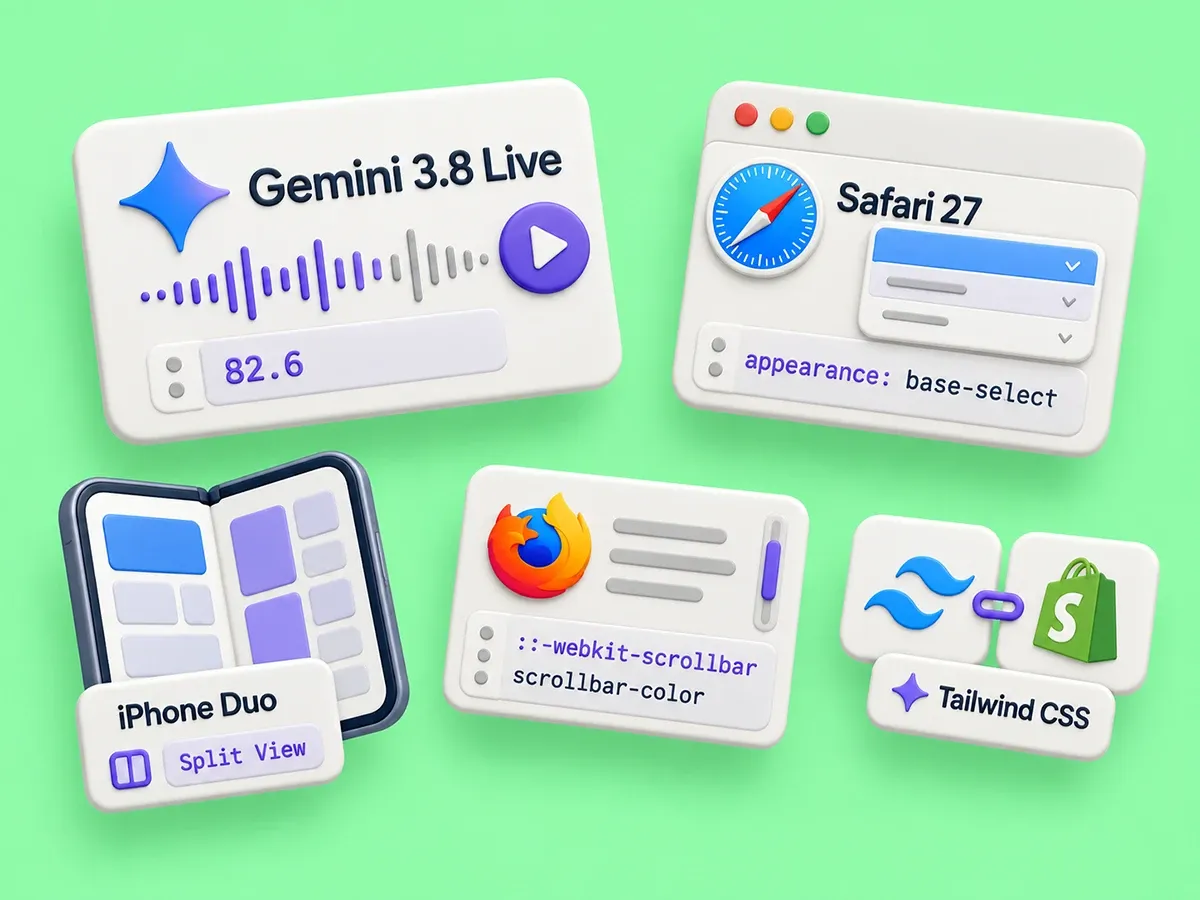
Apple put a sale date on its first foldable iPhone, so screens that fold in half are about to get a lot more common. Google’s live voice models went generally available, Firefox changed a scrollbar check that may unhide styles you wrote, OpenAI deleted the line about training on the mathematicians’ drafts, Safari 27 reached phones, tablets, and laptops, and Tailwind Labs is joining Shopify.
Two new models from Alibaba and DeepSeek
Artificial Analysis scored Alibaba’s Qwen3.8 Max (0902) on September 15 at 45. The Intelligence Index averages one fixed set of hard tests that every model runs. A higher number means a smarter model, and the cost column shows what one of those tasks puts on your API bill.
The new Qwen costs you $5.41 a task, where GPT-6 Astra (max) gets you seven points more for $3.26, 52.81 against 45.44. The other new arrival is DeepSeek V4.1 Flash, which showed up on September 10 at $0.27 a task.
| # | Model | Intelligence Index v4.3 | Cost per Index task |
|---|---|---|---|
| 1 | Claude Fable 5.1 (max) | 53 | $7.63 |
| 2 | GPT-6 Astra (max) | 53 | $3.26 |
| 3 | Claude Fable 5.1 (high) | 51 | $3.91 |
| 4 | Claude Opus 5 (max) | 51 | $5.86 |
| 5 | Claude Fable 5 (max) | 50 | $8.75 |
| 6 | Muse Spark 1.3 (max) | 48 | $1.60 |
| 7 | GPT-5.6 Sol (max) | 47 | $1.99 |
| 8 | Qwen3.8 Max (0902)New | 45 | $5.41 |
| 9 | GLM-5.3 (max) | 45 | $2.01 |
| 10 | Grok 4.6 (high) | 44 | $1.86 |
| 11 | Kimi K3 (max) | 44 | $2.00 |
| 12 | GPT-5.6 Terra (max) | 42 | $1.40 |
| 13 | GLM-5.3-Flash | 42 | $0.25 |
| 14 | Gemini 3.8 Flash (high) | 41 | $1.24 |
| 15 | Qwen3.8 Max | 40 | $2.67 |
| 16 | Qwen3.8 2.4T A95B | 40 | $2.16 |
| 17 | DeepSeek V4.1 Flash (max)New | 40 | $0.27 |
Laying out an interface for a phone that folds
Apple announced iPhone Duo on September 9, its first foldable iPhone. It goes on sale October 23 in more than 70 countries and regions, with another 28 a week later on October 30.
Closed, you’re looking at a 5.4-inch screen, and opening it gives you a 7.6-inch one that folds down the middle. Split View comes with it too. For the first time on an iPhone you can put two apps side by side, or even two windows of the same app, like the Safari next to Safari that Apple shows off. Once people have one of these, the same phone can open your interface on the outer screen, on the whole inner screen, or on half of it while something else takes the other half.
Chrome gives a page two ways to find out there’s a fold.
With the Viewport Segments API you ask how the screen is split, and in CSS you match on how many segments there are with horizontal-viewport-segments and vertical-viewport-segments, side by side or stacked.
From JavaScript you read window.viewport.segments to get the position and size of each one.
The Device Posture API just answers whether the device is flat or folded, and you reach it through navigator.devicePosture or the device-posture media feature.
Browser data updated September 10, 2026
Safari doesn’t support any of that today, which is unexpected given the release of the phone. Apple hasn’t said whether it plans to, either. This means you’ll need to rely on basic media queries if you want to target different orientations.
Google’s two new live voice models are ready for production
Google released Gemini 3.8 Live and Gemini 3.8 Live Extended Thinking on September 15, both generally available to anyone with great ideas. They’re live voice models, which means you talk and the model talks back while the conversation keeps running, closer to a phone call than to typing and waiting. Extended Thinking is the one that can reason and run tools in the background without stopping the conversation. Google’s docs say it fills the wait out loud with lines like “Checking flight options now” instead of going quiet.
Both models are in the Gemini API and Google AI Studio today, with Gemini Enterprise holding them in private preview for now. Google says they’re coming soon to Gemini Enterprise for Customer Experience, plus Extended Thinking for Google Workspace business customers.
On the consumer side both started rolling out the same day, 3.8 Live into Search Live and Extended Thinking into Gemini Live. Extended Thinking also turns up in Docs Live if you pay for Google AI Pro or Ultra, and in Gmail Live and Keep Live for everyone on a Google AI plan.
The two models cost the same, $3.00 input / $12.00 output per million tokens for audio and $0.75 input / $4.50 output per million tokens for text. Google also mentions how much it costs per minute, $0.005 coming in and $0.018 going out.
Artificial Analysis scored Extended Thinking at the top of its Speech to Speech Index with 82.6, over OpenAI’s GPT-Live-1 on 81.5.
Firefox 156 may turn your scrollbar styles back on
Mozilla shipped Firefox 156 on September 15 with a change that can switch on scrollbar styles you thought were off.
Say you style your scrollbars the standard way with scrollbar-width and scrollbar-color, and you only want those to apply where the old non-standard ::-webkit-scrollbar isn’t around, so you wrap them in @supports not (selector(::-webkit-scrollbar)).
Firefox used to say it understood ::-webkit-scrollbar, which made that test false, and your styles stayed off there.
It says no now, the test passes, and Firefox users see them.
Most sites already got this back on September 1 with 155, so pull your own up in Firefox and look.
If the scrollbars come out wrong, change the values on those two properties.
Google’s DevFest is back
Google announced the DevFest season on September 14, running from October 1 to December 31. DevFest is a run of community conferences, each one organized by a local Google Developer Group. The post counts more than 800 of them planned across 115 countries, with nearly a million developers expected to turn up.
The theme this year is “Build, Secure, Scale: Developers and Builders in the Agentic Era”, though each group writes its own agenda and what you get depends on the city. Some events are free and others charge a small fee for the venue and the food. You can find the one near you in the DevFest event directory.
Vercel now protects production for free
Vercel stopped charging to put a sign-in page in front of production on September 9, which used to cost $150 a month as an add-on. Vercel calls the setting deployment protection, and none of your own code runs until a visitor gets past that page. Standard Protection covers every URL except your production domain, so a branch preview sits behind the sign-in while the live site stays open to anyone. If you switch the project to All Deployments, that covers the live site too, on every plan including the free Hobby one. People get in by signing in with a Vercel account that has access to the project. That said, a client who won’t make a Vercel account just to look at a staging site can get a shareable link instead, since that one carries a parameter in the URL.
You can also use Password Protection, where you hand out one password to whoever needs to see the site. That now costs $20 per project per month on Pro, where before September 9 it came inside the same $150 add-on and covered every project you had. On Hobby you can’t buy it at all, while Enterprise teams already have it on every project. Neither changelog post says what happens to a team already paying the old add-on, though the pricing docs say those teams keep their current billing and have to ask support to move.
CSS can (finally) style a drop-down menu in Safari 27
Apple released Safari 27 on September 14 next to iOS 27, iPadOS 27, and macOS 27.
The operating system used to draw that menu, which is why it never quite matched the rest of your design.
Now you put appearance: base-select on the select and on its ::picker(select) part, and from there CSS reaches the closed button, the open list, and every option in it.
You can also make the select’s first child your own <button> with the new <selectedcontent> element inside, so an option holding an icon next to a label shows you both on the closed control instead of one line of plain text.
Chrome and Edge have had all of this since April 2025, and Firefox keeps its half behind settings that are off in every build, Nightly included.
Three more things come with it.
- Scroll anchoring is on by default now, so when an image loads above what you’re reading, the browser holds your place instead of pushing the paragraph down the screen.
- The new
ariaNotify()sends a sentence like “Saved” or “Five results” straight to a screen reader, without the hidden live region you used to need for it. - An MCP server lets an AI coding agent drive the browser while you develop and debug.
Scroll anchoring has a catch for sites that already solved the problem themselves.
Chrome and Firefox have anchored scroll for years, so plenty of sites wrote their own JavaScript to hold the reader’s place while Safari didn’t, and that code now runs on top of what Safari does.
The page ends up scrolling twice as far as it should.
Put overflow-anchor: none on that container to turn Safari’s half off.
Tailwind Labs joins Shopify
Adam Wathan announced on September 9 that Tailwind Labs is joining Shopify, nine years after he started the CSS framework that now gets installed more than 110 million times a week. Tailwind CSS and the team’s other open-source projects carry on unchanged, still MIT-licensed, with the same people leading them and Shopify paying for the work. Tailwind Labs is closing sign-ups for new customers of Tailwind Plus (their ready-made components and templates) and ui.sh (prompts for coding agents that build interfaces), though everyone who already bought keeps their access.
A day later Mustafa Ali wrote that Shopify is moving its mobile apps from React Native back to Swift and Kotlin, undoing the call the company made in 2020. React Native lets you write the app once in JavaScript for both phones, while Swift and Kotlin mean writing it twice. Ali says coding models got good enough that the second build stopped being expensive, so sharing one implementation lost its main argument.
OpenAI deleted the line about training on the mathematicians’ drafts
Last week OpenAI announced a proof of one of the Navier-Stokes statements the same day Levent Alpoge and Tristan Buckmaster published their own. Buckmaster had been feeding every draft of their work into Codex for the whole project. OpenAI’s own post said on September 8 that the company couldn’t rule out that de-identified data from their use of its products had helped improve its models. So people started asking whether the model had been handed the answer it then produced. By September 11 that sentence was gone. OpenAI replaced it with a line saying an investigation confirmed Buckmaster’s Codex prompts “could not have influenced the system in any way, including through training”.
On Mastodon on September 10 Buckmaster wrote that an OpenAI researcher’s account of what the two of them said to each other is “wildly false”, and that two of Sam Altman’s tweets about the episode are false as well. He ends the thread asking OpenAI and the other labs to sit down together and work out how to stop this happening again. Twenty-five winners of the Fields Medal, the best-known prize in mathematics, Terence Tao among them, published a declaration on September 11 called “A Severe Misalignment of AI in Mathematics”. They call the push by AI companies to solve mathematical problems as a benchmark “detrimental to the science of mathematics”, and say solutions announced in a rush leave no time for a proper writeup or for citing earlier work, which “raises severe attribution and plagiarism questions”. The declaration names no company and doesn’t mention Navier-Stokes, and about 7,000 other people had added their names by September 15.
Want more of these in your Google results?