
The Brief #26.36 · Claude Fable 5.1, Gemini 3.8 Flash, Chrome 152, and Cursor loses GPT
Want more of these in your Google results?
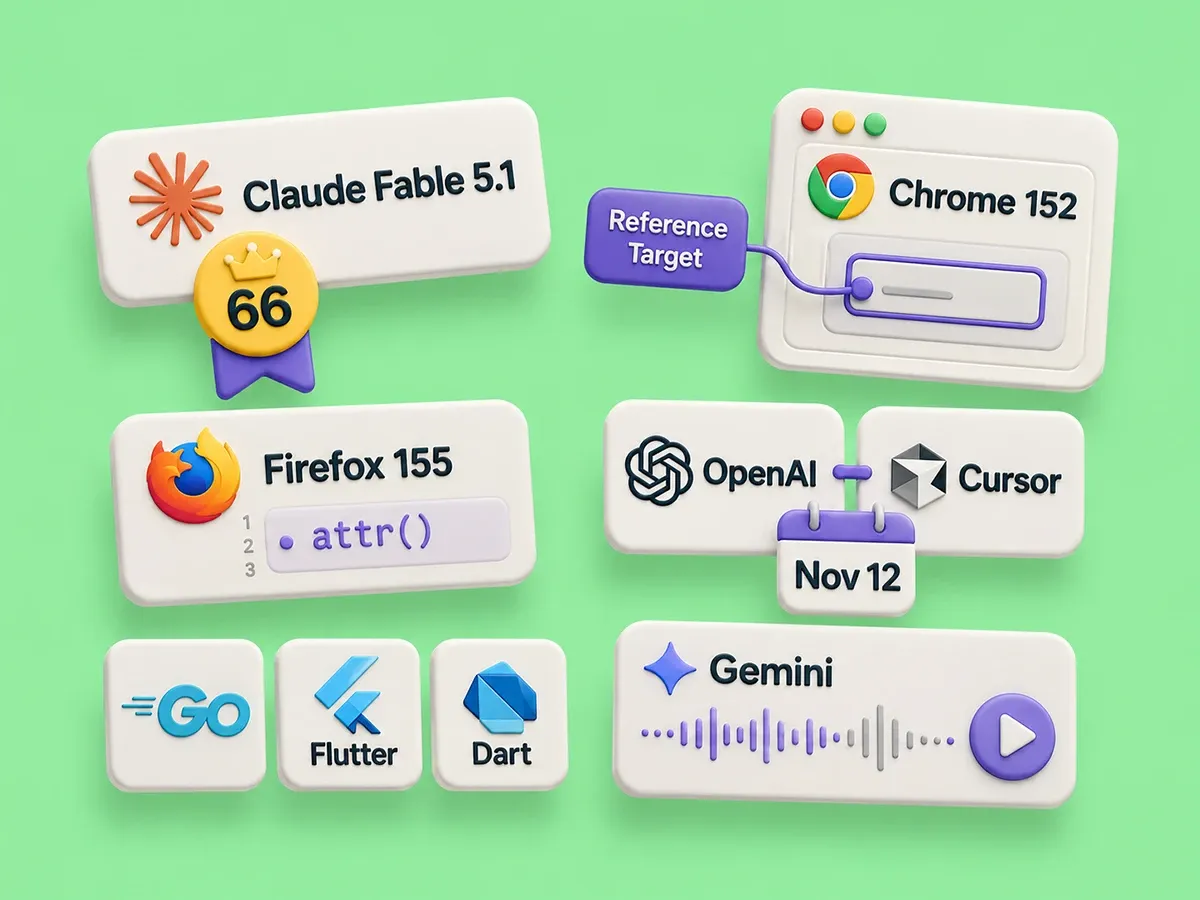
Claude Fable 5.1 took the top of the model table, Gemini 3.8 Flash came in as the fastest model on it, Chrome and Firefox both shipped, OpenAI is cutting Cursor off, and Go, Flutter, and Dart join The Brief.
Claude Fable 5.1 takes first place on the table
Anthropic released Claude Fable 5.1 and Claude Mythos 5.1 on September 1. They’re the same model underneath, with different safety limits on top. Fable 5.1 is the one anyone can use, through the Claude API or the big cloud providers. Mythos 5.1 lifts some of those limits, so it goes only to vetted people and organizations in cybersecurity and life sciences.
On the weekly table Fable 5.1 enters in first place at 66, three points above Claude Opus 5 and four above the Fable 5 it replaces. The Intelligence Index runs every model through the same nine hard tests and reports the result as one number, so higher means smarter. The cost column is the average price of one of those tasks.
The price stays at $10 input / $50 output per million tokens. A cache read, where the model reuses a piece of prompt it already processed on an earlier request, now costs $0.25 per million tokens, 75% less than before. A coding agent resends the same files and instructions on every step, so Anthropic estimates a typical workload comes out about 25% cheaper and long agent runs up to about 45% cheaper.
At max effort Fable 5.1 costs more per task than Fable 5, $3.69 against $3.14, because it thinks for longer. At high effort, the setting Claude Code uses by default, it matches Fable 5’s score at less than half the cost.
Z.ai released GLM-5.3-Flash on August 26, and it joins the table too. It scores 57 for only $0.09 a task, less than a quarter of what Muse Spark 1.2 costs for the same score. The model files are free to download under the MIT license, which lets you run them commercially with almost no strings attached. At 320 billion of them this one needs a server rather than a laptop, so the best laptop-class score on last week’s chart stays 52.
Z.ai also published GLM-5.3’s own model files on August 25, which The Brief was waiting for, so two downloadable models now score 60.
Six returning costs moved, three of them by a cent or two. The bigger shifts were Qwen3.8-Max down from $1.13 to $0.81, Qwen3.8-27B up from $0.25 to $0.37, and Grok 4.6 up from $0.84 to $0.94. OpenAI, xAI and DeepSeek haven’t changed their posted prices, and Artificial Analysis published no note, so read the moves as re-measurements rather than price cuts.
Anthropic also said on August 29 that from September 14 the standard weekly limits in Claude Code rise 25% for good while the temporary 50% boost ends. That works out to a 17% cut from the boosted limit you have today.
| # | Model | Intelligence Index | Cost per Index task |
|---|---|---|---|
| 1 | Claude Fable 5.1 (max)New | 66 | $3.69 |
| 2 | Claude Opus 5 (max) | 63 | $2.34 |
| 3 | Claude Fable 5.1 (high)New | 62 | $1.43 |
| 4 | Claude Fable 5 (max) | 62 | $3.14 |
| 5 | GPT-5.6 Sol (max) | 61 | $0.95 |
| 6 | Grok 4.6 (high) | 61 | $0.94 |
| 7 | Kimi K3 (max) | 60 | $0.84 |
| 8 | GLM-5.3 (max) | 60 | $0.68 |
| 9 | Gemini 3.8 Flash (high)New | 59 | $0.58 |
| 10 | Qwen3.8-Max | 58 | $0.81 |
| 11 | GLM-5.3-FlashNew | 57 | $0.09 |
| 12 | Muse Spark 1.2 (xhigh) | 57 | $0.40 |
| 13 | GPT-5.6 Terra (max) | 57 | $0.53 |
| 14 | Gemini 3.7 Flash (high) | 56 | $0.40 |
| 15 | DeepSeek V4-Pro (max) | 53 | $0.27 |
| 16 | GPT-5.6 Luna (max) | 52 | $0.05 |
Gemini 3.8 Flash is the fastest model on the table, and a second version finds security holes
Google released Gemini 3.8 Flash and Gemini 3.8 Flash Cyber on September 2. The plain one enters the table at 59, and at about 305 tokens a second it’s the fastest model on the table, roughly twice the next one. At $0.58 a task it also costs less than every model scoring above it. Google is charging $0.75 per million input tokens and $3.75 per million output, and both double on January 1.
You can call it from AI Studio, Antigravity, and Android Studio, and it already runs behind the Gemini app and Search AI Mode.
The Cyber version is trained to find and fix security holes instead of writing features. Google says it finds more than 70% of the real security holes it’s pointed at, and that Chrome’s security team gets 2.6 times more correct patches out of it. You have to apply to Google’s Fairwind Program to use it.
All three big labs put out something for security this week. Anthropic’s Mythos 5.1 goes to vetted cybersecurity teams, OpenAI rated its coming Astra model Critical for cybersecurity, and Google built this one for defenders.
Chrome 152 lets a label reach inside a web component
Chrome 152 reached everyone on August 25 with Reference Target, which closes an accessibility gap web components have had from the start. It also carries 327 security fixes, so a browser left open all week is worth restarting.
A component like <my-checkbox> keeps its real <input> in a shadow DOM, the private markup it doesn’t hand to the rest of the page.
A <label for="my-checkbox"> outside the component points at the component itself, never at that input, so clicking the label does nothing and a screen reader announces a checkbox with no name.
Reference Target lets the component say which inner element those references belong to.
The component sets shadowrootreferencetarget on its template and names the input, and from then on anything pointing at the component reaches that input instead.
Only Chrome ships this so far. Mozilla has said it’s in favor and Safari’s team hasn’t said either way.
alpha() is in the same release, and unlike Reference Target it already works in more than one browser, since Firefox shipped it on September 1.
The function takes a color and gives it back at a different transparency, so alpha(from var(--brand) / calc(alpha * 0.5)) halves a brand color’s opacity.
The release also sets a removal date for client-side XSLT, the browser feature that turns an XML file, an RSS feed for example, into a styled page. Chrome drops it in version 158 on November 17, and a site that still needs it can sign up for a trial that keeps it working a while longer.
The HTML standard marked XSLT deprecated that same day and Mozilla filed to remove it, with Firefox switching it off in August 2027, when Chrome’s trial ends.
Firefox 155 ships on the two-week schedule, with typed attr()
Mozilla shipped Firefox 155 on September 1, two weeks after 154 and the first release on the two-week schedule this Brief covered in July.
The biggest CSS change is attr(), which reads a value you wrote in the HTML and uses it in the CSS.
Until now it could only hand over a piece of text.
Now it can hand over a number too, so width: attr(data-size px) turns whatever you put in a data-size attribute into a real width.
Chrome has had that since version 133 in February 2025, and Safari has it only in its preview build so far, so Firefox is the second stable browser to ship it.
Chrome and Safari already ship progress(), which returns how far a value sits between two others as a number from 0 to 1, and now Firefox does too.
The release also adds alpha() and renames font-stretch to font-width, keeping the old name working.
Gemini learns to transcribe, and to skim a video
Google released Gemini 3.5 Transcribe on August 26, a pair of speech-to-text models for the Gemini API. Until now a voice feature had to go through a general model that happens to hear audio. One transcribes live, with under a second of delay, and the other handles recorded audio with speaker labels for up to three speakers and a timestamp on every word. Both detect more than 85 languages, clean up filler words, and accept a custom vocabulary of up to 1,000 terms.
The post quotes Artificial Analysis for the word error rate, the share of words a transcript gets wrong, at 4.0% streaming and 2.6% on recorded audio. Google calls it a public preview in the API changelog, and you can use it today.
On September 1 Google added agentic video understanding to Gemini 3.7 Flash, 3.6 Flash, and 3.5 Flash-Lite through the same API. Until now the model looked at a video one frame per second, whether or not anything was happening, and you paid tokens for every frame.
With processing set to agentic in the request, the model searches the video instead, loading only the frames, audio, or transcript pieces it needs.
Google measured up to 88% fewer tokens, up to 66% lower cost, and up to 7% better accuracy on long videos, at standard token pricing with no extra fee.
That work used to mean picking the frames and segments by hand, and now it’s one setting in the request.
ChatGPT Work and Codex can call the tools your page declares
OpenAI switched on “Site tools” for ChatGPT Work and Codex on August 25, so both can now use a website’s own tools.
Right now an agent uses a website the same way you do, by finding the button and clicking it. WebMCP is a proposed standard that lets the page skip that. The page publishes a short list of things it can do, say “find a section” or “add a comment” in a document editor, and the agent calls one by name.
Chrome only offers it as an origin trial, a limited run a site signs up for while the feature can still change, so the browser side isn’t settled.
Site tools work with GPT-5.6 Sol or Terra, and they’re off for Luna and for Enterprise and Edu workspaces. The browser checks each request before the website carries it out.
OpenAI, Google Chrome, Cloudflare, Shopify, Vercel, Render, and Netlify are backing the idea with a WebMCP Challenge worth $35,000 in prizes. Entries close at midnight UTC on September 4, the evening of September 3 in the Americas.
Go, Flutter, and Dart join The Brief
From this week The Brief also follows Go, Flutter, and Dart, so a new feature in any of them gets a chapter when it ships. Go is Google’s language for servers and command-line tools. Docker and Kubernetes are written in it, and so is the TypeScript compiler since the 7.0 rewrite.
Flutter is Google’s toolkit for building one app that runs on iOS, Android, the web, and desktop at once, and Dart is the language you write that app in.
Go, Flutter, and Dart all shipped bug fixes only this week. Go 1.27 was the last real release, landing on August 19 with generic methods, code you write once that works for more than one kind of data.
OpenAI is cutting Cursor off in November
OpenAI said on August 28 that it has told SpaceX it intends to wind down the contract supplying its models to Cursor, with a proposed shutoff date of November 12. That’s the most notice the contract allows. Cursor is the AI code editor that lets you pick between OpenAI, Anthropic, Google, and xAI models alongside its own Composer models, and it became part of SpaceX on August 14.
OpenAI says it can’t be confident SpaceX will use the models within the terms of service. The post points at two companies Musk already owned, both now inside SpaceX.
X broke its contract with OpenAI after he bought it, and under oath earlier this year, he admitted that xAI had violated OpenAI’s terms too.
The custom agreement gave OpenAI a limited window to cancel after the sale, and it’s using that window while also withholding its future models. The next of those is Astra, which it named on September 1 as the first model it rates Critical for cybersecurity. That rating means the model can find unknown security flaws and build attacks on them with nobody guiding each step.
For anyone using Cursor this is a change in the model list, since GPT-5.6 leaves the editor on November 12 while Claude, Gemini, Grok, and Cursor’s own Composer stay. Michael Truell, Cursor’s CEO, said on August 29 that OpenAI’s models carry about 5% of the editor’s traffic and that the two are talking.
NVIDIA and Hugging Face, still only a report
The Information reported on August 26 that NVIDIA has agreed to buy Hugging Face for $12.9 billion, citing one person with knowledge of the agreement. Hugging Face is the site where open AI models are published and downloaded, a GitHub for AI models.
Late on September 1 Bloomberg reported the two still in advanced talks on a deal of about $14 billion that could be announced this week. Neither company has confirmed it, so this stays a report until one of them speaks.
Want more of these in your Google results?