
The Brief #26.33 · Claude's watermark, Meta's AI on your laptop, and State of CSS 2026
Want more of these in your Google results?
Anthropic explained how Claude will watermark text, Meta released a model that runs on your laptop, and the State of CSS 2026 results show how everyone else writes CSS.
Two new rows in the model table
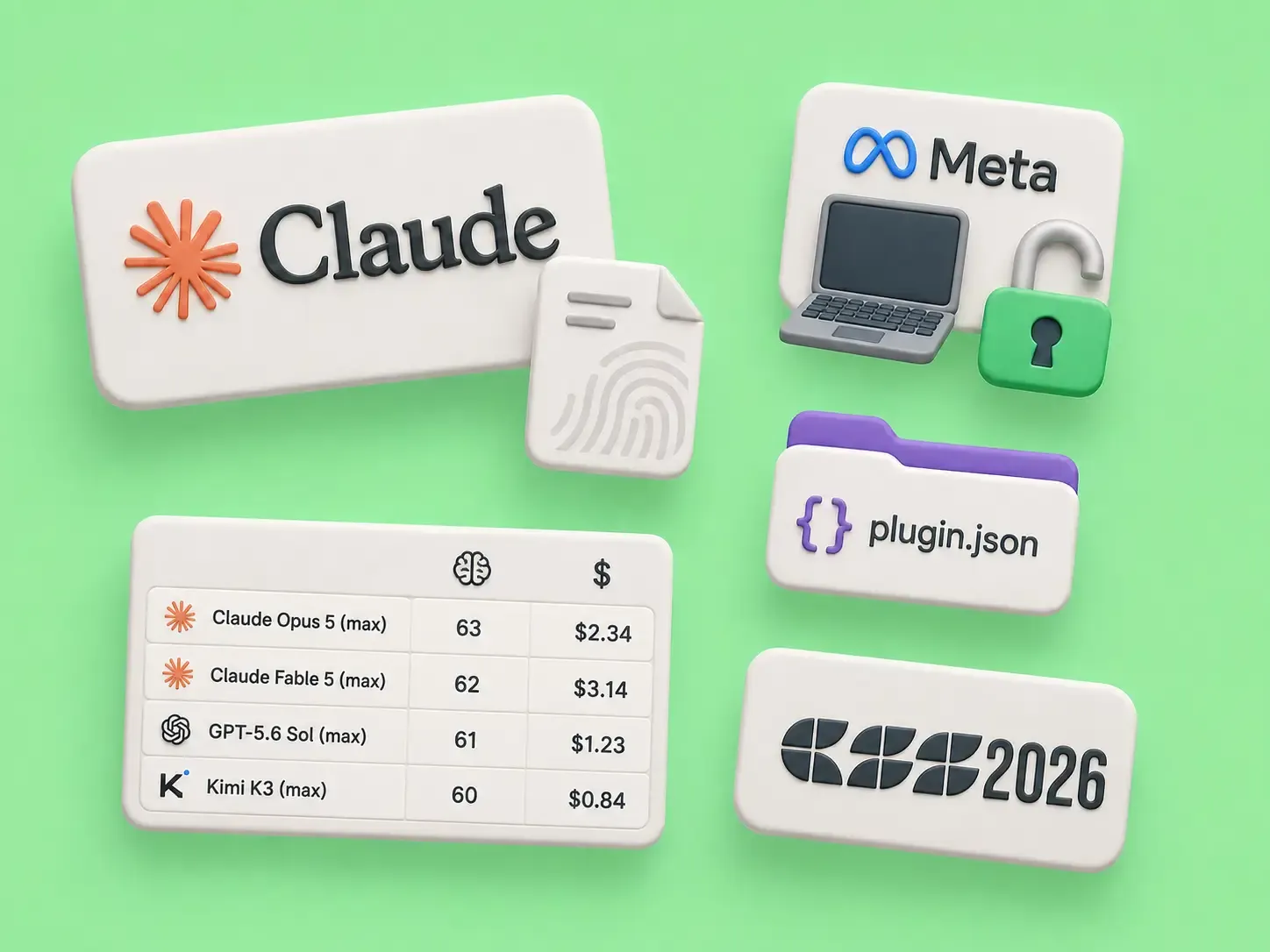
Artificial Analysis now scores Qwen 3.8-Max at 58 on the Intelligence Index, so the model that sat out last issue enters near the top. The Index boils a battery of hard tests into one number where higher means smarter, and the cost column is the average price of one of those tasks.
Alibaba, the company behind Qwen, promised the weights, the actual model files you could download and run yourself, and those are the part still missing. They hadn’t appeared on Hugging Face when I checked on August 12.
The other new row is Muse Spark 1.2, at 57 for $0.40 a task, and the next story explains it. DeepSeek told customers on August 6 that a sizable API price increase is coming, so its $0.03 row is a snapshot, not a promise.
| Model | Intelligence Index | Cost per Index task |
|---|---|---|
| Claude Opus 5 (max) | 63 | $2.34 |
| Claude Fable 5 (max) | 62 | $3.14 |
| GPT-5.6 Sol (max) | 61 | $1.23 |
| Kimi K3 (max) | 60 | $0.84 |
| Qwen 3.8-Max | 58 | $1.13 |
| Muse Spark 1.2 (xhigh) | 57 | $0.40 |
| GPT-5.6 Terra (max) | 57 | $0.51 |
| Grok 4.5 (high) | 56 | $0.36 |
| GLM-5.2 (max) | 53 | $0.31 |
| GPT-5.6 Luna (max) | 52 | $0.05 |
| DeepSeek V4-Flash (max) | 52 | $0.03 |
| Gemini 3.6 Flash | 52 | $0.56 |
Muse Code arrives and Muse Glimmer goes open
Meta shipped Muse Spark 1.2 on August 5 alongside Muse Code, its own coding agent, a terminal tool in beta for macOS and Linux like Claude Code or Codex. The Spark 1.2 under it updates July’s 1.1 for debugging and whole-repository work.
The standard tier runs $1.25 input / $4.25 output per million tokens. A contributor tier costs $0.10 input / $0.20 output per million tokens if you let Meta train on your data, a discount big enough to deserve a conscious decision.
Five days later, Meta released the weights of Muse Glimmer, downloadable under the permissive Apache 2.0 license. Glimmer carries 30 billion parameters, the numbers a model learns in training that together hold everything it knows. It’s dense, meaning every one of those parameters works on every token instead of a few specialist sections handling each request, which keeps its speed predictable on small hardware. A quantized build, compressed to lower-precision numbers so the download shrinks, fits under 20 GB and runs on a Mac or a PC with one consumer GPU.
Artificial Analysis scores it 35, nowhere near the table above, but far above the single-digit median for open models its size. Meta’s own examples are an agent that organizes your files and drafts your messages, a model you can wire to your own scripts so it runs them with the right inputs, and coding help that works with the Wi-Fi off.
Glimmer isn’t a frontier model, just one that answers on the machine where your code already lives, and Mark Zuckerberg said on August 10 the Spark 1.2 weights come next.
Claude will watermark the text it touches
Anthropic published how Claude marks AI-generated content, and the interesting part is how a text watermark can work at all. The company hasn’t published its own algorithm yet, so what follows is the published science it can draw on.
A model picks each next word from a table of probability scores, with some randomness in the pick. The watermark seeds that randomness with a secret key derived from the previous few words. The choices still read naturally, but someone holding the key can later score a passage and see the fingerprint in the wording itself.
No hidden characters are involved, so there’s nothing to strip in a text editor. Scott Aaronson sketched the scheme in 2022 at OpenAI, and Google DeepMind shipped a peer-reviewed version, SynthID-Text, live in Gemini across nearly 20 million responses with no measurable quality drop.
So is Opus 5 marking your text right now? No. Only models launched on or after August 2, 2026 are guaranteed to mark from day one, and both Opus 5, which launched July 24, and Fable 5, which came out before it, miss that cutoff, so no Claude model you can use today is marking anything. Anthropic says it’s still working to bring older models in, so an update could switch it on later, and there’s no public detector yet.
The headline fear, that Claude marks writing you authored yourself, deserves a calmer reading. When you paste your article in for proofreading, the version Claude hands back can carry the mark. That’s why Anthropic says a detected mark means the content may have been processed by Claude, not that Claude wrote it. And a watermark that lives in word choices can’t be added to text that comes back byte-for-byte unchanged.
State of CSS 2026 shows what other developers actually ship
The State of CSS 2026 results went up this week, built from 4,902 respondents, and they show whether the CSS you write looks like everyone else’s.
:has(), the selector that styles an element by what it contains, is in use by 83.7 percent of them.
CSS nesting sits at 70.6 percent, and container queries, which let a component respond to its own box instead of the viewport, crossed half at 52.4 percent.
Anchor positioning, the feature that pins a tooltip or popover to another element in CSS alone, came out both the favorite new feature and the most avoided one, because browser support isn’t there yet. Even after the survey’s largest year-over-year usage jump, only 26.2 percent have used it.
The average respondent says AI writes 28 percent of the CSS they ship, 26 percent don’t let it write any, and the comments repeat that models still write mediocre CSS.
Auto mode becomes Claude Code’s default
Anthropic announced on August 7 that new Claude Code sessions on Pro, Max, and Team plans run in auto mode starting August 14. Instead of asking you to approve each step, auto mode routes every tool call through a classifier, a model trained to block actions that are irreversible, destructive, or aimed outside your environment. The company’s argument is a study of 1,053 paid testers who each faced a planted dangerous command, where the humans caught it 13.6 percent of the time and auto mode blocked 89 percent.
Shift+Tab switches modes any time, administrators can pin a different default or disable the feature, and enterprise and cloud deployments stay opt-in.
ChatGPT’s free tier goes unlimited on Luna
OpenAI updated ChatGPT on August 6, and the biggest change is for the Free and Go tiers. They get GPT-5.6 Luna as the default with unlimited text chats rolling out this week, plus a Think button that gives it more time on hard questions. Limits stay on file uploads, images, and tools.
The update covers ChatGPT the app, not the API. Calling Luna from your own code still costs $0.20 input / $1.20 output per million tokens, the price it dropped to in July, so nothing changes on your bill.
Plus and Pro subscribers get a tuned-up Sol in ChatGPT and a new slider that sets how long it thinks before answering. The company says answers containing a factual mistake now show up about a third as often as they did with last generation’s GPT-5.5 Instant. The change applies only inside ChatGPT, so Codex keeps the Sol it already had.
Ads are what pay for the free tier. They started showing in ChatGPT on August 11 in the United Kingdom, Mexico, Brazil, Japan, and South Korea, and only Free and Go users see them.
Agent tooling agrees on a folder format
Amazon, Cursor, Microsoft, OpenAI, and Vercel published Agent Plugins on August 6, one open format for extending agents, so the same package loads into ChatGPT, Codex, Cursor, GitHub Copilot, VS Code, and Amazon’s Kiro editor. Three pieces make up the format, and each comes with a recommendation.
- Skills, the folders of instructions the agent reads when a task needs them, go in a
skills/folder at the package’s root, one subfolder per skill. A skill isn’t one file, since each subfolder holds aSKILL.mdplus any extra files it needs, like scripts or notes. If you keep prompt docs or anAGENTS.md, copy that text into aSKILL.mdin its own subfolder underskills/. That’s the whole move, and those instructions then load into ChatGPT, Cursor, VS Code, and the rest. - MCP servers, the connections that give an agent access to your tools and data, are listed in one
mcp.jsonfile next toskills/. If you already run one, you just list it there. - The plugin is the folder that holds all of the above, named by a
plugin.jsonfile, and it can hold as many skills and servers as you want. Make one when you keep the same setup in two or more of those tools, and skip it for just one.
The big name missing from the steering committee is Anthropic, which created both the skills format and MCP.
Claude Code isn’t on the client list, so it won’t load one of these packages as-is, because its own plugins use slightly different file names, .claude-plugin/plugin.json and .mcp.json.
Your skills still work in both, since the SKILL.md folders are identical everywhere, so moving a plugin over is a rename, not a rewrite.
Spotify shipped the other piece of agent tooling, Xirp, on August 10. It manages dozens of parallel coding-agent sessions across harnesses, the tools that run an agent for you, with Claude Code, Gemini CLI, and Codex among them. Each session runs in its own worktree, a separate working copy of the repository, so parallel changes never trample each other.
The nearest things today are the VS Code agent panel and hand-rolled tmux-and-worktree scripts. Xirp’s edge is that it’s harness-neutral, free, and built for 50 parallel sessions, a scale neither aims at, though whether it beats them is unknown.
Figma put MCP to work the same week, saying in its release notes of August 11 that its server now runs Weave tools from any connected agent. Weave is the company’s product for building AI workflows over images, video, and audio, and a tool is a saved workflow, say one that turns product shots into brand mockups. Your coding agent runs the tool by name and returns the result in the chat, with no app switch.
The HTML accessibility rulebook got a refresh
W3C published an updated ARIA in HTML Recommendation on August 11, the official rulebook for which ARIA roles and attributes, the markup that tells assistive tech what an element is and does, belong on each HTML element.
Validators and accessibility linters enforce it, so in practice the refreshed edition decides what your tooling complains about, and it now bakes in the rules for the fully styleable select.
Chrome patches 41 security holes, six of them Critical
Google shipped a Chrome 151 stable update on August 6 with 41 security fixes, six rated Critical, the highest severity the project uses, and pushed the same build to Android the same day. All six sit in the browser’s graphics and interface code, five use-after-free bugs, the kind where code keeps using memory it already handed back, and one out-of-bounds write in ANGLE, the layer Chrome runs its graphics through.
The post flags none as exploited in the wild, and the whole ask is letting the browser restart and update today instead of days from now.
Kimi K3 lands in GitHub Copilot
The strongest open-weights model in the table got easier to use at work, since Kimi K3 reached general availability in GitHub Copilot on August 6, on every paid plan. The practical detail is who runs it, because GitHub hosts the model on Fireworks AI rather than sending anything to Moonshot, its Chinese maker. It’s off by default on Business and Enterprise until an administrator enables the policy.
OpenAI names an upcoming model Astra
OpenAI said on August 7 that its upcoming model Astra may end up dangerously good at hacking, and that it isn’t sure yet. Its own safety rules call that level Critical, a model able to find and exploit unknown security holes in hardened systems without human help. Until the question settles, the company has paused the internal Astra work that doesn’t meet its stricter security controls.
Three days later the lab expanded Daybreak, its access program that hands vetted security defenders a GPT-5.6-Cyber model completing 95 percent of the advanced security-testing requests regular Sol refuses. The program already produced a fix that reached your browser. OpenAI ran the model against V8, the JavaScript engine inside Chrome, and found two unknown holes that chained into an escape of the engine’s internal heap sandbox, V8’s own inner protective wall. The code stayed inside Chrome’s outer sandbox, and Google fixed the bug as CVE-2026-15903.
Chips, fabs, and a billion users
Tesla and SpaceX will invest $16.8 billion to start building Terafab, a chip factory in Texas whose filings allow up to $119 billion across phases, and Anthropic confirmed on August 5 it’s building an in-house team to design custom chips for Claude.
And Google said on August 11 the Gemini app passed one billion monthly active users. Read the units closely, since ChatGPT’s headline billion is users per week, not per month.
Want more of these in your Google results?